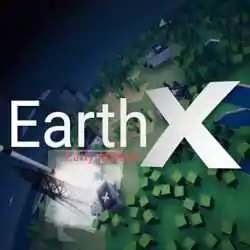
EarthX 2 is a casual space management game built around growing a company from a modest Earth-based startup into a major force in exploration.
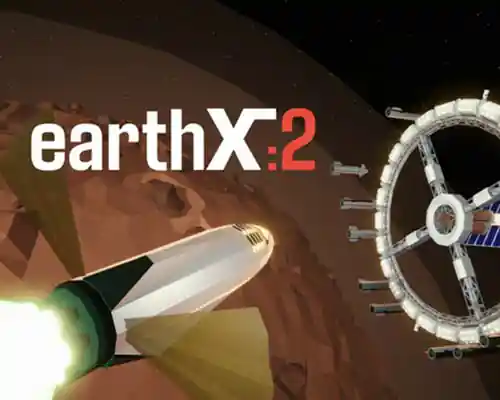
Take a small rocket startup and turn it into a serious space company with operations stretching from Earth to Mars and beyond. Land government contracts, send huge satellite networks into orbit, construct space stations, terraform Mars with nuclear technology, and gather the resources needed to keep expanding.
The pace stays relaxed, giving plenty of freedom to build rockets, reach other worlds, and work toward making humanity a multi-planetary civilization.

Diesel Legacy: The Brazen Age Free Download (Build 17887256)
Build Rockets and Complete Missions
The core of EarthX 2 revolves around manufacturing rockets and sending different payloads into orbit. Rockets come with their own range and payload limits, so choosing the right vehicle for each mission matters. Things do not always go according to plan, either. Launch failures and spectacular explosions are simply part of running a space program.
Contracts add another layer to the gameplay. Missions come with deadlines, so payloads need to reach their destinations on time. There are dozens of contracts inspired by real-world space operations, including satellite deployments, International Space Station resupply missions, and crewed flights. Astronauts can even be transported to space and returned to Earth after six-month missions.
The inventory system makes it easier to manage equipment and payloads spread across multiple planets.
Put Your Launches on Autopilot
As the company expands, the number of launches can quickly pile up. Fortunately, EarthX 2 includes automation tools that take some of the repetitive work off your hands.
Rockets can be programmed with custom commands and assigned specific execution intervals. Multiple actions can also be linked together to create more complex sequences, making large-scale operations much easier to manage.
Build a Satellite Internet Business
Rocket launches are only part of the business. Satellites and routers can be manufactured, launched into orbit, and used to create an independent internet service capable of generating billions in revenue.
Orbit selection plays an important role here. Satellites in lower orbits provide faster speeds but need to be replaced more frequently. Higher orbits extend satellite lifespans, although connection speeds are lower. Satellites can also be upgraded to improve their performance and capacity, giving the business more room to compete.
Research and Experiment
New rockets, capsules, and spacecraft become available through research. Every development project requires both time and money, so choosing what to work on next can have a big impact on progress.
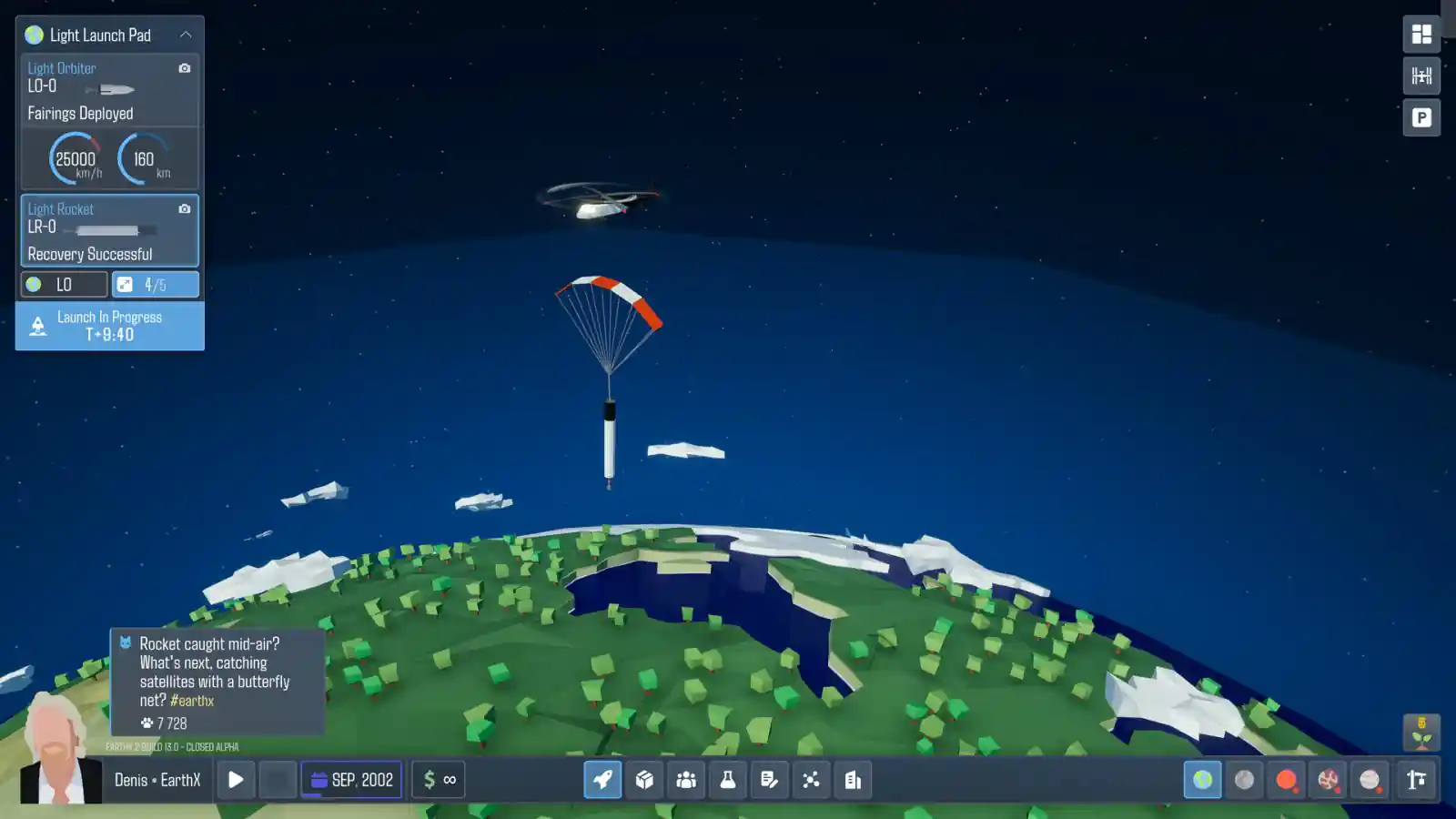
There are also several mini-games tied to special upgrades and features. Landing rockets accurately on droneships, catching rockets with helicopters, and performing the tricky “Belly Flop” spacecraft landing maneuver add some extra variety between larger management tasks.
Expand Across the Solar System
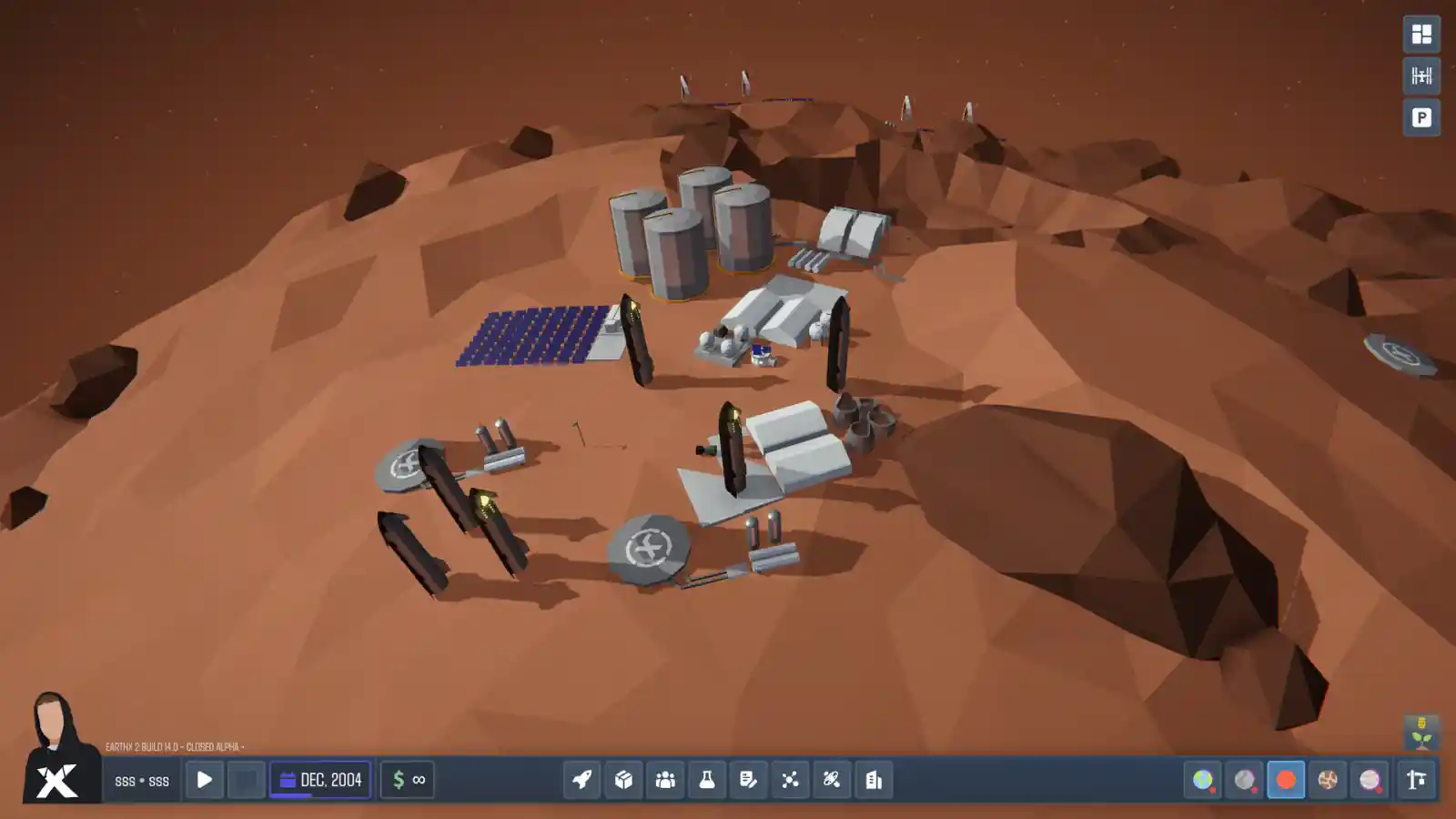
Once the space program is established, operations can extend far beyond Earth. Fleets of spacecraft can be used to reach the Moon, Mars, Phobos, and even Europa.
Features of EarthX 2:
- EarthX 2 uses a clean low-poly visual style that gives the game a cozy look while still providing realistic planetary atmosphere simulations. The soundtrack, created exclusively by MELOKHROMA, adds a fitting atmosphere to the whole space-building experience.
- The interface is designed with flexibility in mind. Important information can be pinned through Quick Access, while windows can be resized and moved around to create a layout that suits different play styles.
- Even large lists remain responsive, and the in-game camera provides a well-tuned view from virtually any angle.
- Overall, EarthX 2 keeps the space-management formula approachable while offering plenty to work toward. Starting with a small rocket company and eventually managing colonies, satellite networks, spacecraft, and planetary-scale projects gives the game a satisfying sense of progression without forcing everything to happen at once.
Minimum System Requirements:
- OS: Windows 10
- Processor: Intel i5 or similar
- Memory: 8 GB RAM
- Graphics: NVIDIA Geforce GTX 750 or similiar
- Storage: 5 GB available space
- Sound Card: Yes
File Size: 771 MB
You might also like:
 EarthX PC Game Free Download (v65997)
- Surviving Mars: Relaunched PC (Feeding the Future)
- Earth vs Mars PC Free Download (v1.0.1.4208340)
- Sol 0 Mars Colonization Free Download
- Life on Mars (MiZtyl) PC Free Download (v1.0 Final)
- Mars Base PC Free Download (Build 19183332)
- Surviving Mars PC Game Free Download
- SpaceCraft PC (Build 24144687 Early Access)